How to Write a Cover Letter With AI (Free & Tailored)
Write a tailored cover letter from a job description and your notes: structure, what not to invent, and how to generate one with free AI — with full examples.
· 7 min read
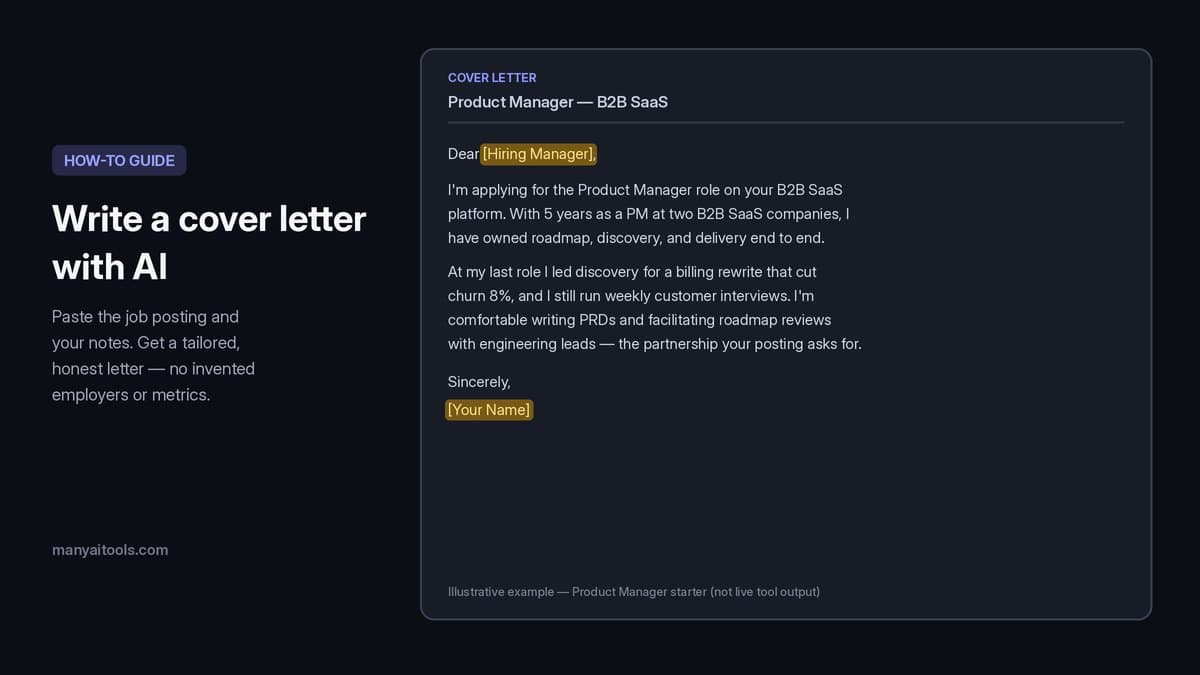
Example letter structure for a sample Product Manager application (not live tool output).
A cover letter has one job: show the hiring manager that you read the posting, that your experience matches what they need, and that you're worth an interview. Keep it to a few short paragraphs, stick to facts you can stand behind, and make every sentence earn its place.
This guide covers what a cover letter must do, a simple structure that works, how to tailor it to a posting without inventing details, and how to draft one with AI from a job description and your notes — with two full worked examples.
What a cover letter must do
A resume lists what you've done. A cover letter argues why this role is a fit. In practice that means three things:
- Name the role and why you're writing. Don't open with "I am writing to express my interest." Lead with the job and one honest reason it matches you.
- Connect your experience to their needs. Pull two or three requirements from the posting and answer them with facts from your background — roles, skills, and results you actually have.
- Close with a clear next step. A short offer to talk or share more, then a sign-off and your name.
Skip flattery about the company culture, skip restating your whole resume, and skip anything you couldn't defend in an interview. A hiring manager will notice invented metrics faster than a slightly imperfect sentence.
A structure that works
Use this skeleton every time. It's boring on purpose — boring is easy to scan.
- Greeting. "Dear Hiring Manager," or a named contact if the posting lists one.
- Opening paragraph. Role + one-sentence fit. About 2–3 sentences.
- Body (one or two paragraphs). Match their requirements to your experience. Prefer concrete wins ("cut churn 8%") over soft claims ("I'm a results-driven collaborator").
- Close. Interest + availability + sign-off ("Sincerely," / "Best regards,") and your name.
Aim for about 250–400 words. Three to five short paragraphs is enough. If a sentence doesn't help them decide to interview you, cut it.
How to tailor a letter to a posting
- Read the posting twice. Highlight must-haves (years, stack, domain) and nice-to-haves.
- List only matching facts from your background. If they want Postgres and you have it, say so. If they want 6 years and you have 4, be honest and lean on related strength — don't invent the missing years.
- Mirror their language where it's true. If they say "customer interviews" and you run them, use that phrase. Keyword mirroring helps both humans and ATS filters, but only when the fact is real.
- Leave placeholders for anything you don't know. Name, hiring contact, portfolio link — write
[Your Name]rather than guessing.
What not to invent (especially with AI)
AI is fast at sounding confident. That is also the risk. Never let a draft invent:
- Employers, job titles, or dates you didn't provide
- Degrees, certifications, or tools you don't have
- Metrics, headcount, or revenue numbers you can't defend
- Soft skills padded into fake "leadership of cross-functional teams of 12" stories
If your notes are thin, a shorter honest letter beats a long fictional one. Good AI cover letter tools are built around that rule: they use only the experience you paste in, and leave placeholders like [Your Name] when a detail is missing.
How to write a cover letter with AI
Our free Cover Letter Writer is built for this exact job. You paste the posting, add a few background notes, pick a tone, and get a paste-ready letter. Here's the flow:
- Paste the full job description. The more of the posting you include, the better the letter can mirror real requirements.
- Add background notes. Roles, years, skills, and wins you're willing to stand behind. Short bullet-style notes beat pasting an entire resume dump.
- Pick a tone. Professional (default), Concise, Enthusiastic, or Formal.
- Generate, then edit. Read every claim out loud. Swap anything that isn't yours. Fill in placeholders.
- Copy and apply. Paste into the application form or attach as a PDF after a final pass.
You can also start from a sample: Product manager, Software engineer, Marketing, or Ops/EA. Each loads a sample job and background so you can see the shape of a good input before you use your own.
Sign in with Google to try it — free starter credits work the same as our other tools. Shared credit packs cover Cover Letter Writer along with email, LinkedIn, and photo tools from one balance.
Cover Letter Writer
Turn a job description and your notes into a tailored cover letter.
Worked example 1: Product manager
The inputs below match the Product manager starter on the tool page. The letter is an illustrative example written for this guide, not a live tool screenshot.
Job description (sample):
We are hiring a Product Manager to own roadmap, discovery, and delivery for our B2B SaaS platform. You will partner with engineering and design, run customer interviews, and ship measurable outcomes. 4+ years PM experience preferred; strong written communication required.
Background notes (sample):
5 years PM at two B2B SaaS companies. Led discovery for a billing rewrite that cut churn 8%. Ran weekly customer interviews. Comfortable writing PRDs and facilitating roadmap reviews with eng leads.
Illustrative cover letter:
Dear Hiring Manager,
I'm applying for the Product Manager role on your B2B SaaS platform. With 5 years as a PM at two B2B SaaS companies, I've owned roadmap, discovery, and delivery end to end, and I'm looking for a seat where those skills ship measurable outcomes with engineering and design partners.
In my recent work I led discovery for a billing rewrite that cut churn 8%, and I still run weekly customer interviews to keep the roadmap honest. I'm comfortable writing clear PRDs and facilitating roadmap reviews with engineering leads — the written communication and partnership your posting asks for.
I'd welcome a conversation about how I can help own discovery and delivery on your platform.
Sincerely, [Your Name]
Notice every claim comes from the notes. The letter mirrors "roadmap, discovery, and delivery," "customer interviews," and "engineering" because those phrases appear in both the posting and the background — not because the AI invented a career history.
Worked example 2: Software engineer
Same idea with the Software engineer starter.
Job description (sample):
Looking for a full-stack Software Engineer (TypeScript, React, Node) to build customer-facing features. You will ship end-to-end, review PRs, and improve reliability. 3+ years experience; familiarity with Postgres a plus.
Background notes (sample):
4 years full-stack with TypeScript, React, and Node. Built API and UI for a notifications service used by 50k users. Comfortable with Postgres and code review. Prefer clear specs and incremental shipping.
Illustrative cover letter:
Dear Hiring Manager,
I'm applying for the full-stack Software Engineer role. I have 4 years building with TypeScript, React, and Node, and I enjoy shipping customer-facing features end to end — from API to UI — with clear specs and incremental releases.
I built the API and UI for a notifications service used by 50k users, and I'm comfortable with Postgres and thorough code review. Reliability matters to me: I prefer small, reviewable changes that improve the product without drama.
I'd be glad to walk through recent work and how I'd approach your stack.
Best regards, [Your Name]
Again: stack, years, the 50k-user service, Postgres, and code review all came from the notes. Nothing was padded.
After you generate: polish and apply
- Edit for voice. Keep any sentence that sounds like you; rewrite anything that sounds like a template.
- Check names and titles against the posting one more time.
- Need a tighter tone? Paste the draft into the Email Rewriter if you want a Concise or Formal pass without changing the facts.
- Interview later? When you get a screen or onsite, a short follow-up email within 24 hours is the right next touch — and you can draft that with AI the same way.
- Updating LinkedIn? A clear headshot helps the application feel complete; LinkedIn Headshot turns a selfie into a studio-style photo if you need one.
Before you send checklist
- Every fact in the letter appears in your notes or resume — nothing invented.
- The opening names the role and a real reason you're a fit.
- Two or three posting requirements are answered with concrete experience.
- Placeholders like
[Your Name]and[Hiring Manager]are filled in or replaced. - Length is about one page (roughly 250–400 words), no fluff openers.
- You read it once out loud and cut anything that doesn't help them decide.
Quick answers
How do I write a cover letter with AI? Paste the job description and a short list of your real experience into a cover letter tool, pick a tone, generate, then edit. Use only facts you provided — replace anything the draft invented.
Can I write a cover letter for free with AI? Yes. Our Cover Letter Writer is free to try after Google sign-in, with starter credits like our other tools. Credit packs are shared across tools if you need more.
Should a cover letter repeat my resume? No. Pick two or three posting requirements and answer them with specific experience. The resume has the full list; the letter makes the case.
What if I don't have a perfect match? Be honest. Write a shorter letter that leans on transferable strengths you actually have, rather than inventing the missing years or tools.
How long should a cover letter be? About 250–400 words, or three to five short paragraphs. Hiring managers skim; clarity beats length.